Anyone who grew up with Indonesian internet cafés knows the unwritten rule: don't download big files. It drags the whole warnet's bandwidth down, and if the operator notices, you're out. WarNet asks what would happen if you broke that rule on purpose, and did everything you could to get away with it.
- GameSeed 2026
- Top 90 of 260
- Team
- 8 people
- Jam length
- 1 month
The idea
GameSeed gave us two themes: "So Absurd, It's Cool" and "Childhood Dreams". Back when warnets were everywhere, I always wondered what it would be like to actually start that huge download and then do whatever it took not to get caught. That was the childhood dream. Turning it into a stealth game, with the operator as the threat and your own PC as the hiding place, took care of the absurd.
How a session plays
You sit at one PC and can look in four directions: your screen, your left, your back, and your right. Open the browser and the download starts. From then on, the game is about hiding what you're doing until it finishes.
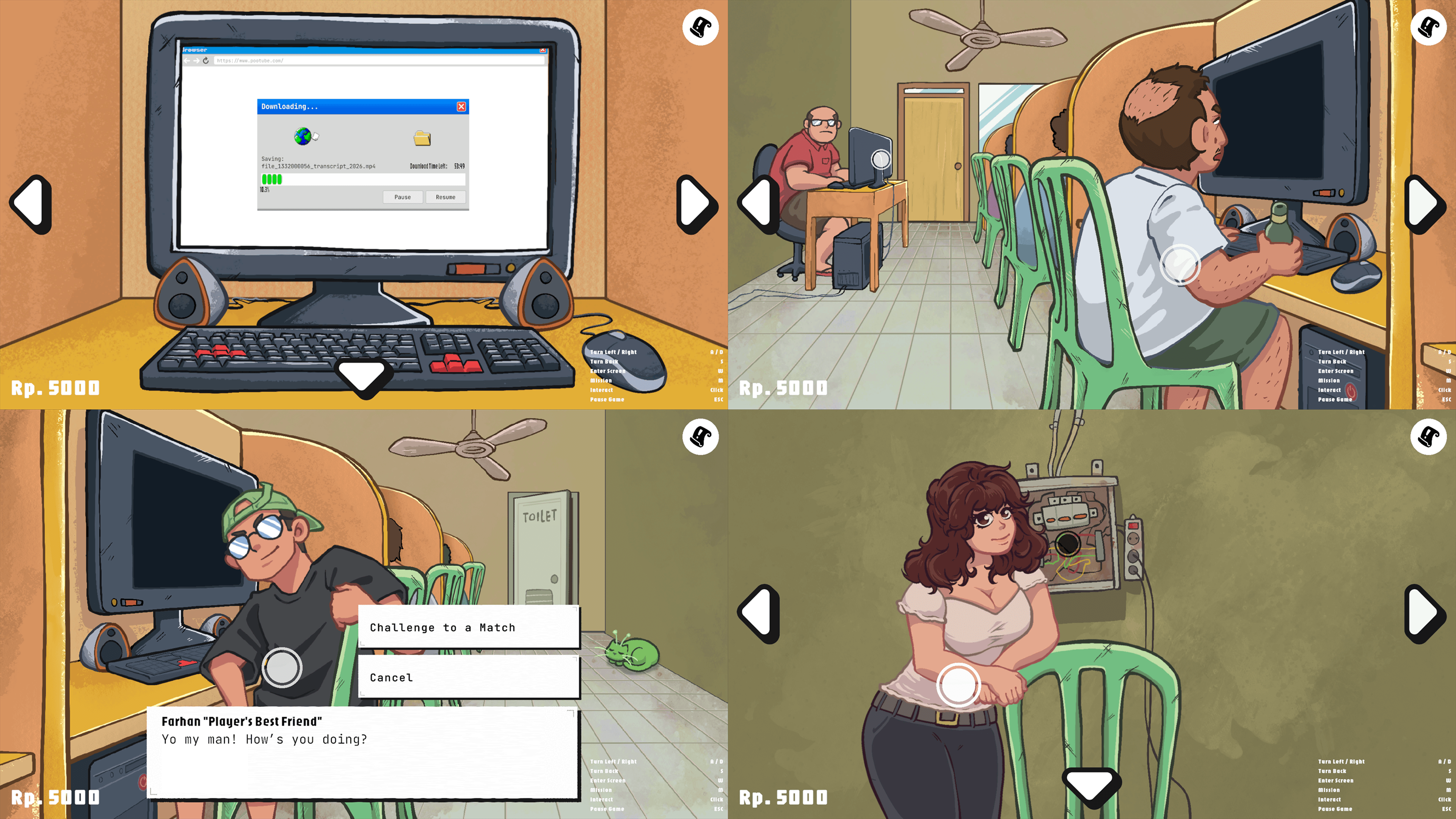
You win
The download reaches 100% before your billing time runs out.You lose
The billing runs out first, or the operator catches you.The suspicion meter
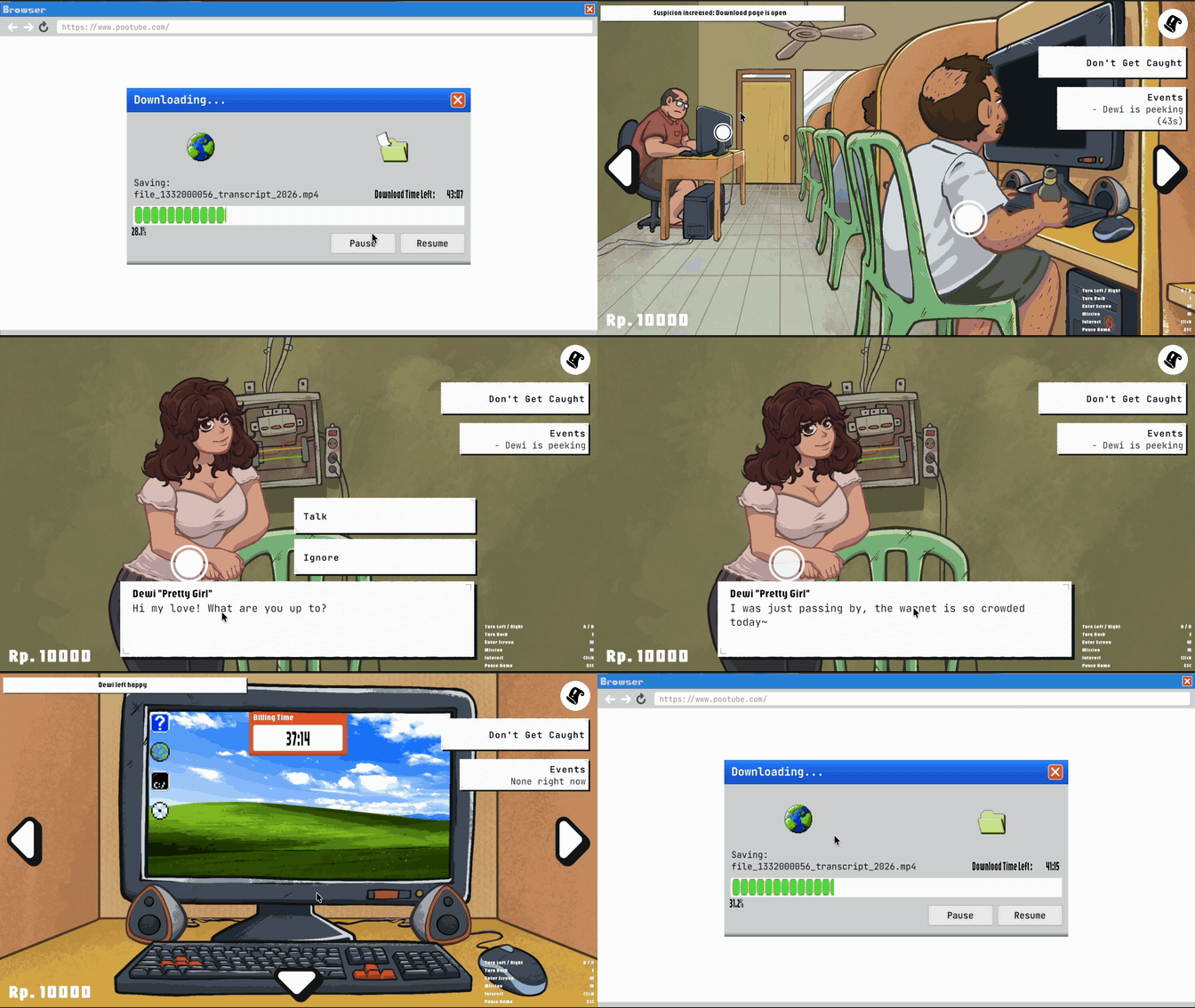
The operator doesn't patrol. They get suspicious, and the meter is how you see it.
- 60The operator comes over and asks what you're doing.
- 90They ask again. Only the right answer keeps you seated.
- 100Caught. The session is over.
Three pillars
My job as game designer was to break the idea down into a few systems the team could build. "Don't get caught while downloading" became three pillars, each one an obstacle or a way around it:
Random events
Things happen around you, often with the people nearby, and you have to deal with them.Side tasks
Cover for the download: chatting, playing games, refreshing pages, looking busy.Abilities
Tools like hacking that buy you room when suspicion climbs.The most absurd moment comes when they all collide: three random events at once, the operator almost sure of you, and you in the middle of a hack.
Design into code
The hardest part wasn't any single system. It was getting the design out of my head and the document, and into the code, with a team of eight. It's hard to make sure everyone has read the design document, let alone understood it the same way. A lot of my month went into explaining the design to the team while we built it.
Small scope first. Get the core loop and mechanics working, then expand and polish.
What we cut
Time ran out before the list did. We cut a lot of random events and side tasks, and I wish we'd had time to polish the game. That's what WarNet taught me: keep the scope small, make the core loop work first, and only then add more.
Team
Game design by ichsanfrds and me. Programming by dyan, Ken, and Waffles. Illustration by PAl. UI and assets by aditfhm and KopiCan. Music by me.